
Linker Vision Announces ESG Agent to Help Cities Plan More Sustainable Urban Environments

BERLIN, Germany, Oct 14, 2026 — Linker Vision today announced a new ESG AI agent designed to help urban planners evaluate sustainability initiatives and make more informed decisions. By combining environmental predictions with AI reasoning, the agent assesses urban heat and shade coverage to guide tree planting and greenery management, supporting cities’ climate adaptation goals.
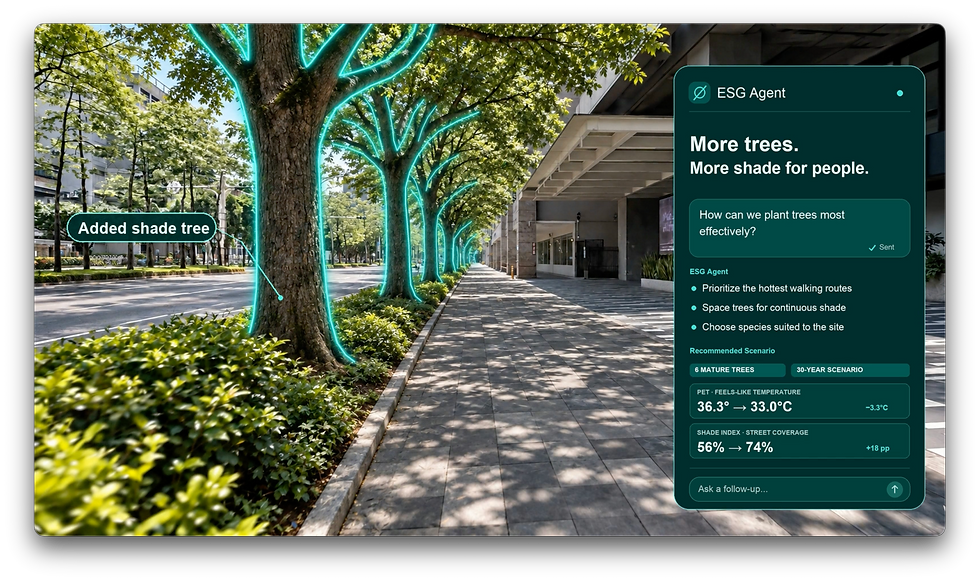
Turning sustainability goals into practical decisions
Linker Vision is working with MVRDV, the Dutch architecture and urban design firm, to explore how AI can help cities assess potential interventions before making changes in the real world. MVRDV contributed scientific data, shaped the evaluation criteria the agent uses to assess planning options, and tested the ESG agent during development.
An initial application focuses on urban forests. Linker Vision is collaborating with MVRDV on a digital twin that supports predictions of urban heat island effects and shade coverage. In the pilot, the agent identifies heat hotspots, selects suitable tree species and simulates the results, projecting that shade coverage could rise from 15.7% to more than 50% within 15 years.
Building on this pilot, the approach allows a shared digital twin to support multiple planning needs, including climate adaptation and disaster resilience. Urban forest planning is available today, and going forward, the city digital twin is designed to serve as a common foundation that government agencies can build on for additional applications, such as analyzing pedestrian flows and preparing venues for major sporting events.
How it works
The workflow combines a digital twin built using 3D Gaussian Splatting with NVIDIA accelerated computing and AI technologies. NVIDIA Omniverse libraries and OpenUSD has been implemented to unify city, tree and environmental data into a single scene, while NVIDIA Nemotron reasoning models let users run planting scenarios and optimize shade through natural language. NVIDIA Metropolis Blueprint for video search and summarization (VSS) and Cosmos open world foundation model help interpret video and understand real-world conditions.
In practice, a planner asks the agent where new trees would best reduce street-level heat. The agent tests planting options and simulates shade and temperature over 15 years timespan in minutes, and planners review the recommended plan before an urban heat hotspot project moves forward.
Designing for future generations
“Every decision about a city shapes how future generations will live,” said Paul Shieh, founder and CEO of Linker Vision. “By connecting real-world understanding with simulation and AI reasoning, we want to help cities explore what is possible and make better choices for people and the planet.”
Learn more about how European cities are using AI agents to transform urban operations on the NVIDIA blog: https://blogs.nvidia.com/blog/european-cities-agents-urban-operations/


